
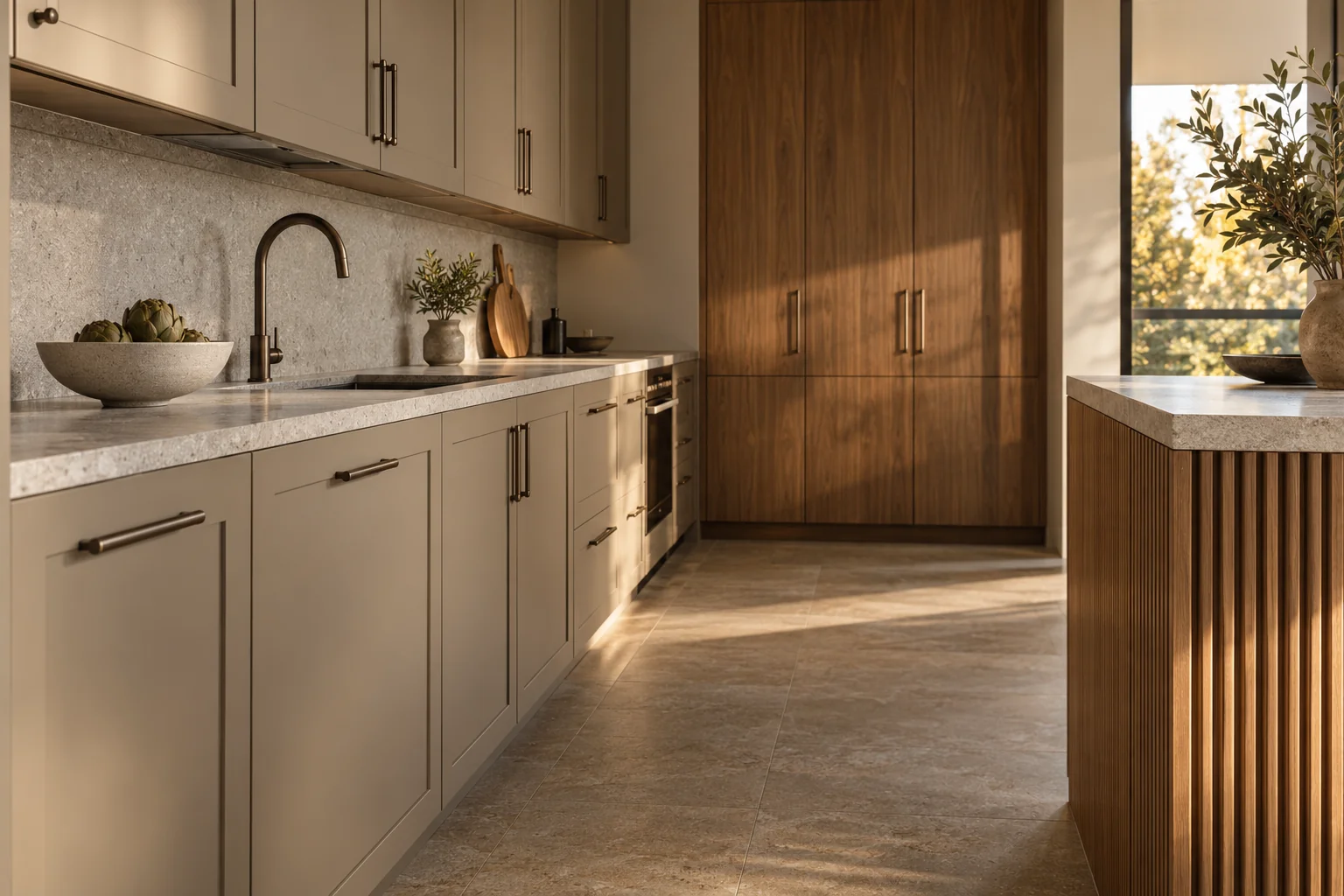
Slab kitchen doors have a flat face, shaker-style doors frame a centre panel, and fluted designs introduce repeated grooves or curves. Choose between them by looking at the whole cabinet run, the drawer fronts and the finishes you plan to retain—not just a single sample.
These are design categories to help you describe a preference. They are not a confirmed Kitchen Revival product catalogue. Ask which profiles, materials and finishes can be supplied for your particular revival before settling on a design.
Slab doors: a quieter face
A slab or flat-front door has no decorative frame around its centre. It can be a useful direction when you want the benchtop, handles or another material to provide the visual detail. A long run of flat fronts reads differently from a run divided by framed panels, even in the same colour.
Flat does not automatically mean glossy, handleless or white. Profile, finish, colour and opening method are separate choices. If you like the flat shape but want a warm room, compare suitable colour or timber-look samples with the flooring and benchtop. Confirm actual availability rather than choosing from a concept image alone.
Shaker-style doors: detail around a panel
Shaker-style fronts have a framed appearance around a comparatively plain centre panel. Frame width and depth change the effect: a fine border can feel restrained, while a broader border is more prominent. Names differ between suppliers, so compare the actual profile instead of expecting every “shaker” door to match.
For example, Kaboodle’s profile guide describes its Alpine profile as having a flat centre and raised border, similar to shaker styling. That is a manufacturer example of the shape, not an indication that Kitchen Revival supplies that range.
Look closely at short drawer fronts. A frame that looks balanced on a tall cupboard door may read differently on a shallow drawer. Ask how the chosen design is handled across your particular combination of doors and drawers, and whether a sample or drawing can show the proposed proportions.
Fluted fronts: texture with a stronger rhythm
Fluted designs use repeated vertical or horizontal detailing to catch light and create texture. The depth, spacing and direction of that detailing affect the result. A subtly grooved surface and a deep curved flute are not interchangeable simply because both are described as textured.
Polytec’s door-profile information describes its Cove design as concave fluting that can be used on doors or feature panels. This illustrates one form of fluted detailing; it does not establish the materials or profiles available through Kitchen Revival.
As a design exercise, compare using texture across an entire run with limiting it to a feature. The latter can let the rest of the kitchen feel calmer, but it depends on which surfaces are included in your project. Ask to see the sample in side light, and ask for cleaning instructions for the exact surface. Do not assume a style name tells you how it should be maintained.
Check the door style against the whole kitchen
Before deciding, place your preferred samples beside the surfaces you expect to retain. A makeover is a composition of existing and new elements, so the splashback, floor, window frames and appliances matter.
- Drawer rhythm: will the profile look balanced on both large doors and small fronts?
- Handles: does the shape suit the profile, feel comfortable to grip and fit the proposed fixing position?
- Visible ends: how will panels, fillers and kickboards relate to the new fronts?
- Benchtop detail: will its colour and pattern complement the door design or compete with it?
- Lighting: do you still like the sample under the room’s evening lights?
A useful comparison is to keep the colour similar while comparing profiles, then compare colours once the shape is shortlisted. This makes it easier to identify whether you are responding to the door shape or simply to a favourite shade.
A preferred style still needs a fit check
Choosing a new face does not confirm that it will work with the existing cabinet boxes and hardware. The team needs to assess measurements, hinge arrangements, clearances and the proposed components. A drawer front and the drawer box behind it are different parts; ask which is being replaced.
Bring up any sticking doors, damaged edges or other concerns before agreeing to the style. Our guide to retaining kitchen cabinets explains the observations worth sharing. If you mainly want a colour change and are deciding between keeping or replacing fronts, describe that goal when you enquire rather than assuming a new profile is necessary.
Make a shortlist that is easy to discuss
Choose two or three reference images and explain what you like in each: a slim frame, a flat face, the direction of the texture or the relationship between the doors and handles. Label them as inspiration, not a specification. A reference image may show a product, material or layout outside your project’s scope.
Ask for the proposed profile name, finish, relevant care information and a clear description of doors, drawer fronts and visible fixed panels in the quote. Kitchen Revival offers coordinated revivals involving replacement fronts, handles and assessed benchtop overlays; do not assume a standalone supply-only door service.
For help turning your preferences into an enquiry, use our kitchen makeover planning checklist. You can then discuss your preferred door style with Kitchen Revival, with suitability and availability confirmed for your own kitchen.
Written with AI assistance for Kitchen Revival’s homeowner guides. General planning information; your kitchen and the proposed products need individual assessment. No supplier relationship is implied by the references above.
Your kitchen. Its next chapter.
Tell us what works and what you’d love to change.
Explore your kitchen revival