
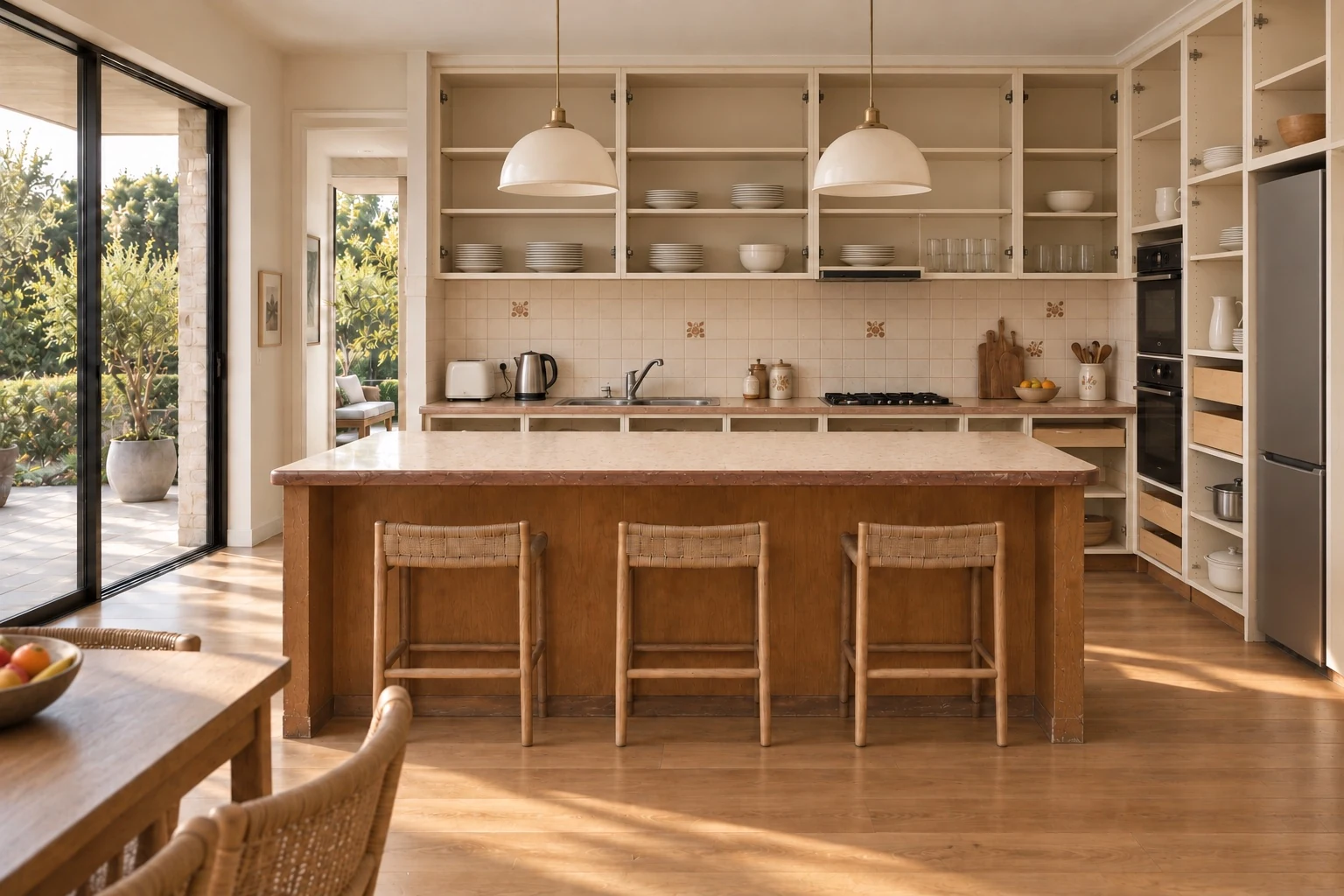
Kitchen refacing usually means replacing the doors and drawer fronts while retaining suitable cabinet boxes. Resurfacing often means renewing a finish on an existing surface. The names alone do not tell you enough: ask what will physically stay, what will be removed and what will be fitted.
That distinction matters if you like your layout but dislike the old door profile, colour or benchtop. A quote for painting existing fronts and a quote for making new fronts can describe very different work, even when both promise a kitchen makeover.
What do refacing, resurfacing and painting mean?
Refacing: changing the fronts
With replacement-front refacing, suitable cupboard carcasses stay in place and new doors and drawer fronts are fitted. A drawer front is the visible face; the drawer box behind it is a separate component. Replacing one does not automatically replace the other.
Ask whether the proposal includes handles, hinges, drawer hardware, exposed end panels and kickboards. These details should be written into the scope rather than inferred from the word “refacing”. A new door style also needs suitable dimensions and hardware; a photograph cannot establish that everything will fit.
Resurfacing: renewing an existing finish
“Resurfacing” is used for different treatments, so ask the provider to name the process and product. Is the existing front being painted, coated or covered? Is the original door staying? What preparation is included, and how are damaged edges treated?
Painting is one example of renewing a surface. As a manufacturer example, Dulux describes its Renovation Range Cabinet Doors coating for laminate, melamine and wooden doors. That illustrates a coating approach; it is not a recommendation for your particular substrate or a description of Kitchen Revival’s service. Product suitability and preparation need to follow the chosen manufacturer’s current instructions.
Choose the method around what bothers you
Write down the change you want before collecting finish samples. “I want a lighter kitchen” leaves several routes open. “I want to remove the routed pattern on every door” is a much more specific brief.
- The colour is the main issue: compare retaining and refinishing suitable fronts with replacing them. Ask to see the proposed finish and understand its care requirements.
- You dislike the door shape or profile: replacing fronts can change the face itself. A new colour alone does not remove the existing shape.
- The door faces are damaged: identify whether the problem is limited to the fronts or also affects the cabinet structure before deciding.
- The layout frustrates you: new fronts will not move the sink, widen a walkway or create a different cabinet arrangement.
For the broader decision about retaining a layout or starting again, see our makeover versus full renovation guide.
The benchtop needs its own scope
Do not assume a cabinet treatment describes the benchtop work too. An overlay adds a new surface over an existing benchtop; replacement involves removing the old top. A coating is another kind of treatment. Ask which is proposed and which existing components remain underneath.
Kitchen Revival’s approach combines replacement doors and drawer fronts, updated handles and an assessed stone benchtop overlay while retaining suitable cabinetry. It is not a cabinet-spray service. The revival process explains that approach. The existing benchtop and proposed system still need individual assessment; a visual example does not confirm a particular material, edge or waterfall detail is available for every kitchen.
Ask for a component-by-component proposal
Use these questions to make two proposals easier to compare:
- Doors and drawer fronts: are they new, or are the existing ones being treated? Which faces and edges are included?
- Visible fixed surfaces: what happens to end panels, fillers, kickboards and visible cabinet edges?
- Hardware: which handles, hinges and drawer components are retained or replaced?
- Benchtop: what stays underneath, and how are edges, joins and appliance openings addressed?
- Condition: what happens if assessment reveals a problem outside the quoted scope?
- Handover: what written care information and applicable warranty terms will you receive?
There is no universal winner on price or durability based on the method name alone. Compare the actual scope, specified finish, condition of the existing kitchen and written terms. Our guide to what affects kitchen makeover cost helps organise that comparison without relying on headline prices.
Prepare a useful enquiry
Take one wide photo of the kitchen, a close view of a door profile and photos of any damage or exposed ends you want changed. List the things that already work and the things you want the finished kitchen to do differently.
If the layout works and the cabinet structure may be suitable, read the cabinet suitability guide, then tell Kitchen Revival what you would like to change. Ask for clarity about the physical work first; choose colours and handles once the proposed scope makes sense.
Written with AI assistance for Kitchen Revival’s homeowner guides. General planning information; your kitchen and the proposed products need individual assessment. No supplier relationship is implied by the references above.
Your kitchen. Its next chapter.
Tell us what works and what you’d love to change.
Explore your kitchen revival